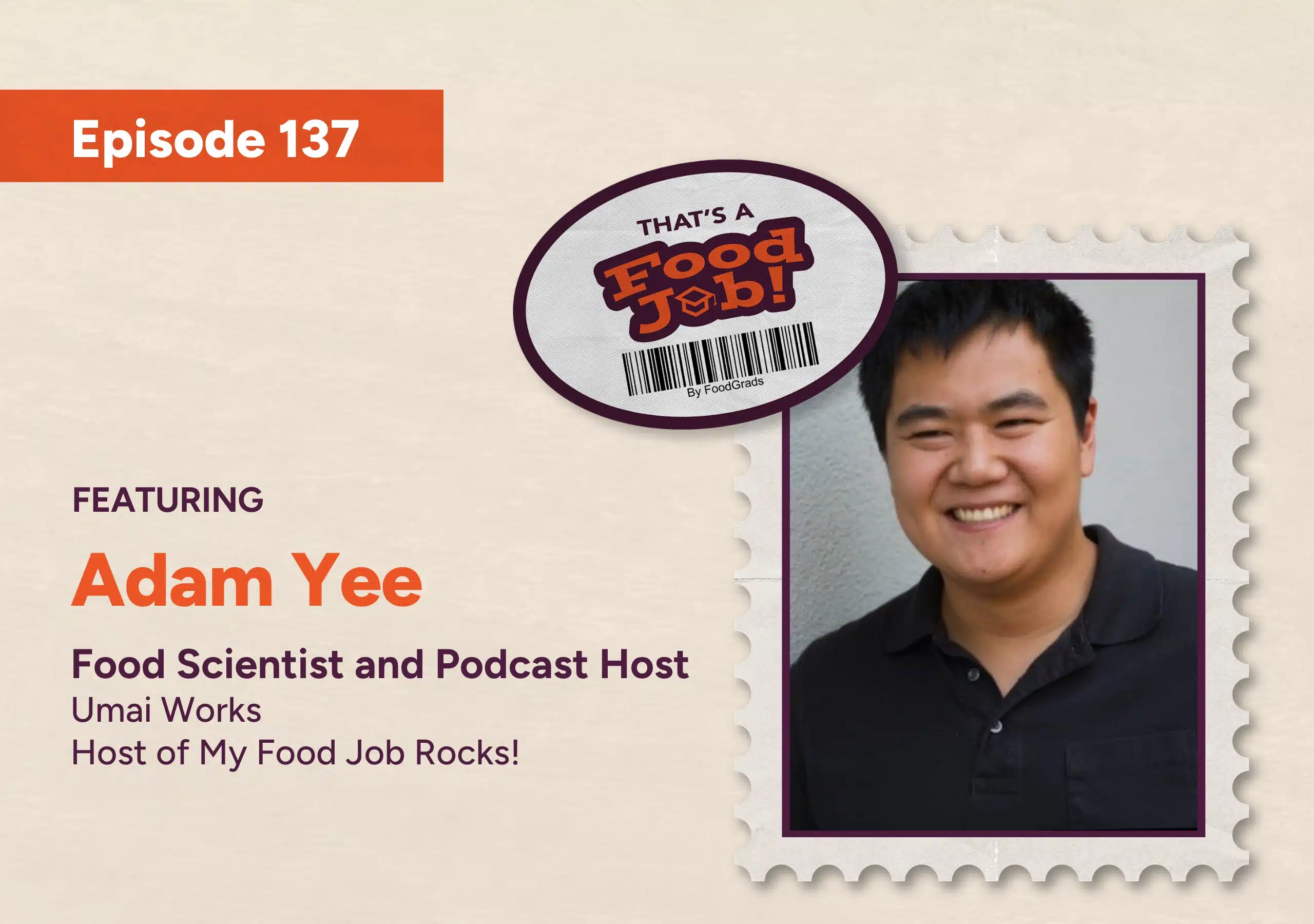

Food Scientist, Entrepreneur & Podcaster: Career Insights with Adam Yee | That’s a Food Job! #138
Adam Yee joins us for a full-circle conversation about career pivots, AI in food science, and the power of trying more things.
What you’ll learn
- How curiosity across multiple disciplines generates better ideas
- What happens when your career identity changes over time
- How food scientists are beginning to use AI tools in their work
- Why communication and marketing matter for technical professionals
- Practical advice for students trying to gain experience and stand out
About this episode
Adam Yee is a food scientist, serial entrepreneur, and podcaster, and the host of My Food Job Rocks, the weekly interview show that helped inspire That’s a Food Job! When FoodGrads’ founder wanted to start a podcast in 2016, Adam stepped up to help and made the idea his own. More than a decade and 300 episodes later, it is one of the defining podcasts in the food space.
In this full-circle conversation, Adam and Veronica talk about what it feels like to shift your professional identity, from founding plant-based meat companies to helping food businesses through his consultancy, UmaiWorks (a consultancy is a business that gives expert advice to other companies). Adam is also studying at North Carolina State University, where he is building a 12-week workshop to help food science staff and students learn to use AI.
They also get into how he keeps up with so many areas of food science, what scientists can learn from marketing, and his advice for students who want to build up their own bank of ideas.
Timestamps
- 00:00 – Intro
- 04:52 – What Adam Does Today
- 06:23 – San Francisco vs. North Carolina
- 08:29 – Adam’s Path to Grad School
- 14:45 – Adam’s Work in Grad School
- 19:12 – Shifting Your Professional Identity
- 27:00 – Science Communication
- 31:42 – Why Read a Marketing Book
- 33:25 – Staying Curious and Retaining Knowledge
- 37:55 – A Typical Day
- 42:40 – Coming Up With New Ideas
- 44:23 – Advice for Students
- 48:25 – Marketing Books Worth Reading
- 52:31 – Closing
Mentioned in this episode
Transcript
0:00 Adam Yee I think when you have this curious mind and you have a mindset that essentially you understand ideas come from a lot of different ideas ping pong each other and they when they collide, it makes a new idea. The more ideas that I am interested in, the generally the more they combine and then eventually one will combine good enough where I believe it’ll work. And I think through all the innovations I’ve done through my life, just in hindsight, it’s all because of an insight from kind of some ideas that seem to have worked out. Generally these insights are more mainstream. I think a lot of scientists go out of stream and then they have two really out there ideas combined together and no one cares because they’re two really out there ideas. Generally for mine it’s always like mainstream and then there has to be something kinda unique that can penetrate the mainstream just a little bit and then kinda ride the current.
0:55 Veronica Hislop Welcome back to another episode of That’s a Food Job, the podcast where in every episode we interview professionals in the agri-food sector about their food jobs. Back in 2016, Food Grad’s founder Nicole Gallace had an idea. She wanted to create a first-of-its-kind podcast where listeners could hear directly from people behind the food industry and show why the food and beverage industry is such a rewarding place to build a career. But Nicole did not want to tackle this idea alone.
She turned to the food community, and the person who stepped up to help was Adam Yee. Adam is a food scientist, serial entrepreneur, and podcaster. He took Nicole’s concept and made it his own. My Food Job Rocks became a weekly interview show, and he has kept showing up week after week for over a decade. With more than 300 episodes later, it is one of the defining podcasts in this space. And he didn’t stop there. The show has grown and delved deeper into topics that are more than just food jobs. And Adam has even gone on to host Food Product Facts, Maybe Food, Maybe Tech, and most recently Startup CPG’s RD Radio.
Off the mic, Adam runs UmaiWorks, which is a consultancy that helps food companies tackle innovation challenges. One week, Adam might be working on a chili crisp, while the next week could be something related to AI. It really depends on what’s sparking his curiosity.
I also have a personal reason for being excited about this conversation. My Food Job Rocks is the show that helped to inspire this very podcast, and we’re gonna talk about it today. Along the way, we will also talk about what it is like to shift your identity, how AI is showing up in the food and beverage space, and why building skills in an industry over time—so really being good at something—is so important. This interview has been a long time coming and I’m excited to share it with you. So without further ado, let’s talk to Adam.
Well, thank you so much for coming on the show, Adam. I think it’s been a long time coming. I mean, you are in part why the podcast started here and for myself to actually have the person who inspired me to start a podcast, it’s great to be able to have you on the show. So thanks for sitting down with me, Adam.
3:10 Adam Yee Love it. Honored to be here. And you know, I love talking about myself, even though I talk to other people, I really truly enjoy just talking about myself.
3:20 Veronica Hislop Like I give you credit for that. It’s a skill. For myself, I feel like that’s one of the changes that I’ve gone through through grad school and even doing the podcast. Like I’m still really nervous about talking about myself, but I think it’s definitely gotten better. I think more personal life stuff is related to that. So I think you’ll make the podcast much easier for me to talk about.
3:39 Adam Yee Yep, for sure, happy to help and happy to inspire you. And it’s always really nice to see what happens. You know, Veronica, you helped me a lot in the start of My Food Job Rocks when you were essentially doing articles for me for free, which unfortunately now AI can do it, but at the time people were actually really engaged in your content specifically. They were generally like the stats, you were generally kind of the top search article when people were looking at flavors. So, you know, I didn’t pay you anything for that.
4:10 Veronica Hislop Cookbooks, you got me cookbooks. They’re still sitting on my shelf. So we’re all good. It was good for me. I forget that I do it. Like honestly, I sometimes forget that was it. But anyways, you’re gonna be talking about yourself today. And I mean, there’s so many resources, like there was the podcast that you were just on. But today I wanna talk about you in like grad school with your consulting work and AI, because I think in the AI and the food space, we just hear AI and we think of chatbots and ChatGPT and I know that there’s a lot more to it. So I’d love to just start by talking about what you presently do. Could you tell us a little bit about your grad school, what you’re in, your area of expertise, and we’ll let you go from there.
4:52 Adam Yee Yeah, so I do like to trip a fine line between a lot of different sectors right now. So it’s really hard to define me, but I usually just say from a business point of view, I’m Adam Yee, I’m a food scientist, serial entrepreneur, and podcaster. I actually don’t talk a lot about the fact that I’m in grad school. Sometimes at conferences when I’m speaking, I’ll joke, “Yeah, I go to grad school and I use consulting to pay for it,” which is true. I have a pretty good consulting business. I call it UmaiWorks, which means “tasty and skillful” in Japanese, and it sounds nice, it sounds short, it has a cool yellow branding logo. And all I do is help food businesses out. And it’s been really nice doing that, just kind of—I don’t want to say even on the side, it’s starting to get bigger and bigger. But having that and combining that with where I’m currently at in North Carolina State University has been really fun, it has been really fulfilling, and it’s just been a definite change of pace. I moved to North Carolina about eight months ago from the San Francisco Bay Area—which we’ll probably dive into a lot more about that—to explore a key thing that I was really curious about, which is essentially how people are viewing AI technology. And I think that gave me a lot of just—I don’t know, a change of pace in life. It feels a lot more like my head’s feeling a lot clearer, and it’s just been really nice in general just being here.
6:23 Veronica Hislop Nice. And how would you say is the difference in feel between San Francisco, which is just like a hub of the food space and all that? And I’m not myself too familiar about the hubs except for I think Austin, Texas, is really building up right now. But like how is it for North Carolina? Is there a big food scene there?
6:40 Adam Yee So there’s a big underlying food scene. And you know, I think when we think about the food scene, what does that really mean? Every city is different and unique, and I’ve lived in like seven different cities, so I would say each one of them had a different type of scene. So I would say in North Carolina, there’s a lot of actually surprising commodity infrastructure—like sweet potatoes is a big one, peanuts is a big one. A lot of research and extension programs actually funnel through North Carolina. The CPG space, or the Consumer Packaged Goods space, which I’m heavily involved in, is pretty small here, but there are some big players; they’re kind of more quiet. Big issue though is that since it’s spread out through all of North Carolina, it’s really hard to get people together. And there is a community. There are some really, really cool and humble and friendly people. I’ve met a lot of friends—Piedmont Pennies is one, and then Seal the Seasons, I’m just going to shout those out—who were just awesome brands that have really big footprints, but are really humble, and I found that really unique. San Francisco though, well that’s a little different. I would say that it gravitates more towards food tech. There’s also a higher net worth population there, therefore they can afford more expensive products, and therefore you get a trickle down of more consumer packaged goods companies because honestly, that type of business targets people with higher net worth because they can afford the products there.
8:05 Veronica Hislop Okay, so I can see the differences between the two. And then okay, let’s talk a little bit about grad school, because I know that you’ve been doing consulting work for a while and you don’t need to have a grad degree to do consulting work, but you made that jump to do it and I’d love to talk about—I know you had that paper that you were involved in a while ago. Was that kind of like the start to getting you there? Would you be able to talk a little bit more about that?
8:29 Adam Yee Yeah, so the start was actually getting fired from my second startup. And in hindsight it was pretty traumatizing. No one wants to admit it, but I was feeling a little lost. And I’ve known NC State for a long time; they keep on inviting me to their school every year to speak, which has been really fun. And that’s been happening for like three years consecutively. A professor there, Dr. Gabriel Keith Harris, was a big fan of the podcast; I interviewed him. He was actually the top-running podcast for a long time—I think Carol McGee took him over—so he was also inspired to make his own podcast too, called Wolfing Down Food Science, with another friend of mine at NC State, Paige Luck. And so I just kept on being invited there. And then when I got fired from my startup, we planned this North Carolina thing before I got fired, so a week before I was like, “Man…” So I went to North Carolina and I did a little talk there, and in hindsight I was just really shaky and still frazzled from the whole experience. I also went to North Carolina for another reason as well—this is going to get kind of long-winded, but I think this is really good to understand the value of connections. There was a professor at Cal Poly where I graduated from undergrad, her name is Dr. Amy Lambert. We reconnected and I was telling her about some stuff, and then she invited me to be an advisor for this project. It’s a USDA grant—it’s starting to get some legs right now—called First in PD, which basically allowed us to revitalize and teach product development to essentially food science professors. And I was an advisor there along with a senior scientist at PepsiCo, named Mary Caruncia. And we actually got along quite well and we talk every so often about stuff. But then I met another professor at NC State, Dr. Fernanda Santos, an assistant professor so she was really new, trying to get her reputation in. I enjoyed talking to her. And then when I was there at North Carolina doing the talk after I got fired, I asked her, “I’m thinking about grad school. I’d love to explore that and I think you’d be a great person to essentially be my PI, right? But what do you call it? I always think of it as private investigator, but is it…?”
11:00 Veronica Hislop Okay, so actually principal investigator—I just say supervisor. I don’t even say PI. Yeah, supervisor is what I use.
11:08 Adam Yee Alright, I think it’s principal investigator, whatever.
11:12 Veronica Hislop Yeah, I feel like supervisor is bigger in Canada. Like no one uses PI if I re—
11:18 Adam Yee I see. Yeah, interesting. So that was like the start of it. But I would say what kind of catalyzed it was a friend of mine in the food industry connected me with a Stanford PhD computer scientist working on a sustainability project about essentially trying to figure out how we can use large language models in food science. And something that they had available was—my friend worked at a company called Nectar, which is part of Food System Innovations, which has this essentially really big free sensory database that we were able to get a lot of data on how people feel about plant-based foods and have them taste it and all that. And then we had all this great data, and they had me in to advise this computer scientist to evaluate how we can use large language models to improve this data or see if there’s any opportunities in this data. We were able to—I had to vet a lot of model outputs. So basically when they put the sensory data or the ingredients or the nutrition facts in there, it would spit out a way to improve it through certain prompting. And so I had to evaluate the prompt, I had to evaluate the model output. At the time it was ChatGPT o1. And we got some pretty good data on how to do this, and we found that we were able to publish it. You know, my colleague Anna Thomas—I was surprised actually I was a co-author or what—she put that in there, and I was like, “Okay, well, that shows some legitimacy; I have my first research paper from Stanford,” which, you know, is…
12:58 Veronica Hislop Pretty good, pretty good. It’s a yes, yes it is.
13:00 Adam Yee Nice to say. And so I was able to convince Dr. Santos at NC State saying, “Hey, if Stanford’s doing this, then what is everyone else doing?” And the answer is everyone else does nothing. Everyone is not doing anything learning about large language models. Because if Stanford is literally the center of AI in San Francisco—like two or three years ago San Francisco’s all about AI, AI, AI—what is everyone else saying? So what I discovered talking to NC State is that basically no one else is doing AI except for San Francisco and maybe some coastal stuff. No one has a firm understanding of AI besides San Francisco, in my opinion, because people can say that and say, “Yeah, we know we’re doing AI initiatives,” and all that, but San Francisco’s light years ahead. So I was like, “Okay, well, this would be kind of good to study further.” And I convinced Dr. Santos to explore this project with me or explore opportunities about this. And luckily that data or that research paper we did—I also need to plug this in here, but we also were able to spin that off to a project that got two million dollars from the Bezos Earth Fund. Jeff Bezos’s Bezos Earth Fund. I don’t see a lot of that money, but that money’s being well spent somewhere else in San Francisco, building something pretty cool. So I’ll stop there, I’ll stop there.
14:30 Veronica Hislop Okay, okay, that’s a lot to take in. And just so my understanding is that you’re more exploring how it’s being used, AI and food, rather—like it’s more of a topic exploration study rather than developing models or doing those types of things?
14:45 Adam Yee So what my first six months at NC State told me is that one, we’re really interested in using it; two, we don’t know how to use it. So the department has specifically—his name is KP Sandeep—really, really wants to understand this technology and really wants his staff and students and all that to use it. So he saw me as—we were talking about this and so he took the initiative to make an AI forum. So every—twice a month we would go in, get a lecture about AI. It was a little—it was very informal, but it taught me a lot about how the people of North Carolina feel about AI. And basically the answer is graduate students have a lot of hubris and think they know everything, which is—you know, I’m just going to say that. I’m just going to say that. And then staff don’t know anything about AI. So that taught me a lot about, okay, there’s a really interesting disconnect there. And so what I did propose for this semester, which is starting next week, is to create a decently structured AI workshop to teach AI adoption. So if I were to summarize what I’m really focusing on here is that we have the technology, it’s in San Francisco, it’s doing pretty well in San Francisco, but not a lot of people are using it. And there’s a huge opportunity in teaching people how to use AI. And what we saw from the survey that I was able to drum up—and we got a good amount of responses from this survey, over 50 I think—is that people just don’t have a way, like a—I don’t want to say a safe space, but a place to talk about using it. And I think that’s kind of the core of the workshop, this 12-week workshop I’m doing at NC State, is to really explore that. That probably will turn into something related to my masters, but right now it’s essentially how do we upskill the people, the food science staff, researchers, students about using simply large language models.
16:47 Veronica Hislop Okay, so simply large. And the focus is on other students in universities right now?
16:53 Adam Yee Right now it’ll be in the food science department, and it will probably be—and because I’m a food scientist who’s really involved in the food industry, it most likely will stay there.
17:02 Veronica Hislop Okay. Yeah, because I think that’s an interesting topic, because I—since I started my grad school, I started 2019. So that was like pre-COVID. And then I think LLMs started really getting popular 2021. So basically, I’ve been seeing a lot has happened since I started my grad thing. And there’s just a lot of confusion, first of all, even just ownership of—if I use it, is it considered my own work? And I feel like universities, which are supposed to be on the cutting edge of research, aren’t always there. And there’s always unclarity about whether or not you should even use them and what model, and is it plagiarism, is it not considered plagiarism? And it’s just, how do you decipher even what to use? I mean, we all do use it, obviously, like my supervisor encourages in terms of quick research and all that. But again, I’m always hesitant because I’ve seen pre-these studies what it’s like to research something. So I had my base knowledge prior to it. So I think for me it’s more of the plagiarism aspect. Like if I use it, is my thesis gonna be thrown out? There’s not a lot of clarity right now in that.
18:13 Adam Yee Yeah, I will say every single professor, every single student, every single department has their own opinion about AI. And I don’t think we’re gonna have an overarching ordinance about using this for a long time, just you know how slow some of the administrative stuff goes. And I think that that’s the most difficult part. And we’re—even you could argue corporate, which I do have a toe in, also has various opinions about using AI. The difference between a company that has a lot of private data, for instance, versus a company that maybe is a VC firm or whatever—different departments will adopt it faster depending on how they feel about data security, for lack of a better term, is what we were seeing. So I think the answer is we’re probably not going to figure it out, and it’s still at a phase right now where I don’t think we’re going to figure it out for a long time.
19:12 Veronica Hislop Yeah, no, I think so. We’re just kind of muddling through the waters trying to figure out what works and what doesn’t work. And you know, one thing that you had mentioned earlier that I want to talk a little bit more about is just like you’ve kind of changed your identity in a way now that you’re part of being a grad student or like you’ve done consulting work and you’ve done the business throughout—like you’ve done a lot of different hats and all that. And have you ever felt with these identity shifts—has it been something that’s been difficult for you? Have you even thought about it? I know for myself, personally it’s been a challenge as a grad student—I still don’t feel like I’m an expert in my field, but I probably am considered, at least that’s for me. But coming to grad school, how has it felt? Have you felt an identity shift yet?
19:57 Adam Yee So yes, I have. But I will say it’s actually more on a business owner front than actually on a grad student front. I really don’t feel like a grad student. Like I just tell people, “Yeah, I pay for grad school to make friends and get access to research.”
20:13 Veronica Hislop Those are expensive. So I guess I’m gonna miss when I lose it; it’s gonna be hard.
20:18 Adam Yee Yeah. There’s a lot of perks in grad school. So the library is open twenty-four seven, the food is really good, and it’s relatively cheap. So I don’t see myself as a grad student, I will say that. I will say what has changed though is that more professionally for me is what kind of scientist am I? And right now, in the past, I was a plant-based meat scientist. I started two plant-based meat companies—both are still alive, Better Meat Co, or they’re not called BMC ingredients, and then Sobo Foods. And I tied my whole identity of being an entrepreneur and being specifically a plant-based entrepreneur. So in a hot field that’s now not so hot anymore, like that actually was more existential than being a student or whatever I am now. And being fired, I think caused some trauma there as well, like, okay, what is my identity? And everyone gets fired, everyone gets laid off, and I think in general that’s now feels like a rite of passage in a sense for most people in terms of their identity. But for me, this gave me an opportunity to kind of pivot to essentially being a food scientist—specifically a food scientist that can help other companies make their food businesses. One of the things I’m thinking about more on LinkedIn, for instance, is my headline. I put “food scientist for impactful work; I solve business problems using food science” because I’ve been there before. And so I have the experience and the mistakes to teach other people in a food science perspective how to do that. And I think most food scientists haven’t started their own business to the extent I have, if not twice. And I think that’s at least the thing that I have felt to be more impactful in terms of my identity rather than being a grad student. For me a grad student is just being, okay, I’m with academics, I have this advantage of being in that area and of having access to really smart people who are very dedicated to the academic world. But I would say that is more, now that I think about it, a perk for what I’m currently doing now.
22:34 Veronica Hislop I’m happy you brought up the plant-based thing because I was gonna ask you about that. That’s kind of that switch between plant—cause I knew you for a lot of your work was that, and now more to the AI space, but now more food scientist. So like we can say that you’re like a proud food scientist.
22:51 Adam Yee I would say I’m still uncomfortable about AI, right? Like I don’t think I’ve earned my stripes to be called an expert on AI quite yet. We’ll see after the masters, we’ll see after the masters program, because we do have some really cool stuff cooking up that I’ll probably be talking a lot more about it in the future, but definitely I do have a lot of experiments that I’m really excited to show as we kind of progress through my master’s.
23:18 Veronica Hislop I love that. And so onto that food science identity—I think food science is still even a really broad field in that. And I was just curious about, you know, for me, it’s so hard for me to keep up with everything. Like the most I can really keep up with is in my space and then general conversations. But you know, to be a food scientist is to be a food chemist, to be a food flavorist, to be a food biologist—like even that space is really massive. So when looking into being a food scientist, like where do you—I guess, how do you keep up with it? Like how do you keep up and learn different topics? Because they’re so broad, especially when you do your consulting work, like there’s a whole space and you haven’t been an R&D manager for each of them. So like I guess, where do you learn more about it? And—
24:06 Adam Yee That’s a really good question. So I think that was something of a dissonance that I’ve had, was actually shifting from plant-based meat to essentially a generalist. And I work with a lot of dairy, I work with one or two meats, some protein bars, a lot of supplement work, and powder work. The good news is I’ve had some past jobs where I had to switch categories before. So one example is like granola bars to protein bars, and protein bars to plant-based meat. There is a general cadence of how to make a product, and I think if you strip down the framework of anything in terms of a category perspective, it is roughly the same thing. You connect with ingredient suppliers, sometimes you can leverage them for advice on how to make a product, or they’ll give you something called a model formula for you to do. Luckily I had some work in the ingredient industry to understand that as well, through a company called Motif Foodworks and Better Meat Co to some extent too. And then I would say I do use large language models to get a really good baseline of how to make these products. And I have specific prompts that I use that allow the large language model to search up the internet, to give me a formulated, essentially batch sheet or formulation. And then I test it and then there’s stuff wrong about it, and then I learn from that. I also baseline—like food safety and baseline food chemistry, like how proteins, fats, and carbohydrates interact with each other, is kind of the fundamental for any product, is what I’ve learned. And packaging requirements, and the fundamental of science still applies for every type of food product; it’s just we change it differently. There are some things I won’t touch, like high-technology products like RTDs or ready-to-drinks, because they’re just way too risky and way too expensive to take a risk at. There are other experts for there. There are some products I generally stay away from. But I think in general what I’ve learned through my career—and I’ve had a lot of jobs, I will say that—is that the good news about doing multiple different jobs is that you kind of develop this pathway or framework that is generally made to make food products. And then if you can use AI or large language models to fill in the structural gaps of what you don’t know, but still combine it with the knowledge that you do know—and honestly, this is the test it out; don’t just splay it out or just send it and literally have to test it out or say to them like, “Hey, this is kind of our proposed thing that we’re gonna try and we’re gonna see if it’s gonna work”—I think that is fine to do. I mean, I think that’s fine to learn as well, as you’re using AI for your work, especially professionally.
27:00 Veronica Hislop I guess as you’re speaking, what my mind goes towards is thinking about like one of the struggles that I have as doing my PhD research and that—like I have to be able to really speak about what I like; if I’m talking about physical chemistry, like I have to be able to talk about it and it’s not always something like I can share, I can prompt something or I can write about it. But when you’re put on the spot in those conversations, I have to be able to articulate that. And I guess with the work that you’re doing, like the goal is to maybe make an effective product, like doing what you’re like that kind of demonstrates the knowledge that you’ve built, right?
27:37 Adam Yee Correct. You know, I think people my age probably are the best use cases of using large language models right now because we can understand when it says things wrong. And I think that’s kind of the most important part. Unfortunately, younger generations now, they don’t have the practice to really understand if something goes wrong. So you’re kinda right on there. You know, I will say PhD people are really smart, but they think they’re not that smart, which I think just boggles me because there are a lot of people who don’t have—or bachelors their first year—who think they’re really smart and they make a lot of money, right? So I think it is actually more of a confidence thing. And it’s also a pitch thing, too. So I can’t explain how to sound like an expert; it’s really difficult, but I think it requires a lot of practice.
28:33 Veronica Hislop Yeah, that’s true. It’s—I find it’s hard to get those—like again with my research, it’s really in-depth in terms of talking about the molecular level. Sometimes I—even though I’m a food scientist, I think of myself more of a physical chemist who does food, because it’s like really—
28:49 Adam Yee Well, food’s applied science, so—
29:02 Veronica Hislop Like for me, okay, so how do I want to put this? We get really in the nitty-gritty of things and sometimes it’s hard to articulate what I’m talking about. And then, you know, you talk to others and it’s just like—if I talk to my partner, he’s just gonna—I could say anything and it would be right in terms of the science behind it. So I guess it’s just that skill of that practice. It’s always—
29:25 Adam Yee So yeah, no, this is good, because I think what I’ve learned is like what really shuts up PhD students or academics is like, “So what? Why does this matter?” And they get stumped. Like I do have conversations with professors all the time and sometimes when we go pretty deep into things, I just realize they’re looking for more questions rather than getting more answers. Mm-hmm. And for me as an entrepreneur and someone who’s very business-minded, all I care about is the answer. And so this has actually shown me a lot when I’m talking to people in university, is that why does this question matter, or what we are talking about matters? And I think that really stumps a lot of people who are really deep into it, because—and maybe they get an external prize about it, whatever—but in general, that’s what I’ve noticed to be the most interesting thing about sounding smart: that people can sound smart and never answer the question, but I think sounding smart is giving the answer. And I—
30:29 Veronica Hislop Okay. Okay. I guess that’s a way of looking at it. But I think what you say does point out the difference between academia, which is like, yeah, thinking—my professor, it’s always the why: go deeper, go deeper, go deeper. And I think that’s a struggle when a lot of students do go to the real world. Is that I have a student who’s in my program and she just recently graduated; she’s working in food now. And she’s just like, it’s—they just want the answer. Like they don’t want to know the molecular thing. She’s like, “I’m not used to this.”
31:01 Adam Yee Yes, exactly. And I think that’s something I see to be kind of like the detrimental problem honestly. This might be a rant, but I see this as a detrimental problem, that we’re not teaching students to give answers; we’re just teaching them the question mark, which is good, but it’s the opposite of what industry wants.
31:18 Sue / Veronica Hislop Yeah, I know. And I think that’s even why I asked about the identity question earlier on, because I think that, you know, mine is always searching for answers, or like searching—even though you’re searching for answers, you’re creating more questions with it. But that identity shift is a little bit difficult ’cause marketing yourself differently, because you’re not used to just being, you know, very simple answers and like those things. You always feel like there has to be more of a deep dive: why, why, why. So—
31:42 Adam Yee Yeah, I gave this advice on another podcast, which is most scientists should read a marketing book. Like—
31:53 Veronica Hislop No, I do appreciate that my supervisor tangents with that. He also is always just like, “Just try to be able to talk about your research, and what’s your elevator pitch in like sixty seconds? What’s the application?” Even though you might not really have an application, like make it so that there is one. So there’s—
32:12 Adam Yee Go ahead. No, no, I agree with that. I think—so I consume a lot of marketing content. I also like to understand how marketing works. So for me, I read a good amount of marketing books, I listen to a lot of influencers in marketing, because for me it helps me understand what people actually resonate with. And I think if scientists are ignoring that field, which is a huge field, which is there for a reason, I think that is a detriment, honestly, to communication. Specifically the science communication is not literally studying marketing, at least reading about it after you graduate or whatever.
32:48 Veronica Hislop Yeah, no, I a hundred percent agree. It’s part why I got a marketing degree—pardon me, marketing minor—when I was doing my undergrad, because when I worked in industry for my little co-op term, I was like, it’s the marketing people that we gotta be able to convince our idea of and like those—and a lot of the stuff. But like I have to ask you, like, how do you find the time to listen to all these different topics, or like remember? Because like I think for me, I don’t know if it’s like—I just don’t have the best memory. Like I write my notes and all that, but I just—how do you manage to find all this information and then retain it? ‘Cause I—it’s hard for me.
33:25 Adam Yee Huh, good question. I’m very curious, obviously. I think I make my own curiosity; I think that’s a very strong thing. So, you know, podcasting is one example, right? Like I reach out to people that I think are smarter than me and I ask them to be on the show. I can get an hour-long conversation with them to learn about their life essentially. And I think, you know, when you do it for 300 times or more, you eventually get a knack for it for these types of things, right? You understand what’s important. You also do—you know, I do a lot of internal testing. I don’t write it down or anything, but what resonates with people when I say this? I think startups really do concentrate a lot of learnings because you are—and I talk to a lot of ex-startup founders and I talk to a lot of ex-people in startups, people especially in food tech where everyone got laid off. Like they have a very concentrated learning of what has happened throughout those years. And in fact, the biggest challenge is they can’t really express that concentrated learning when they try to get a normal job or a normal food science job, because food science jobs go really slow compared to these food tech startups that are really concentrated. But the good news is that some turn entrepreneurial, some have made really good organizations through that concentration of learning. So that’s one thing that I really enjoy. I think I’m just really good at expressing what I’ve done in my life too, which is a different, decent type of skill. I don’t think a lot of people do that. So I mean, as you know, I write about my life, and I think I put a lot of time into that and it allows me to reflect a little bit more and allows me to feel happier about what’s going on, about my life and kind of reminisce about it. And then people read it and then it’s like, “Wow, you’ve done a lot.” Well, it’s because I kind of illustrate it in a sense, right? I think that’s really important—like journaling helps with that a lot, or one could argue drawing or painting can illustrate or make your life feel a little bit fuller. It’s kind of a way of saying, like, I just do a lot of things; I still have hobbies, and I still waste my time doing random stuff, which—you know—
35:40 Veronica Hislop I was gonna ask about that because like I know that you were in—correct me if I’m wrong—campaigns and like D&D, like am I wrong with that? Like do you actually do that as well?
35:49 Adam Yee Well, I don’t do that anymore, actually, funny enough. So usually when I move to a new city I go to a completely different hobby. Okay. So I got burnt out actually in San Francisco. I actually made my own game book at that point. Yeah, that’s yeah. It’s called like—someone actually bought it like yesterday, so it’s just like, “Well, that’s so interesting.” They reached out to me to buy it though, because I disabled everything.
36:16 Adam Yee But like yeah, I really enjoyed that type of art project, I would say. You know, for me, D&D—Dungeons and Dragons—was just a really good creative—I just don’t have the bandwidth, or not the bandwidth—I will say I don’t have the interest of doing it anymore for some reason. I don’t know why, but that’s fine. Like that arc of my life was really fun, really enjoyable; it allowed me to become a better speaker, a better storyteller for lack of a better term, right, because I was the—they call it the dungeon master, which is like the guy who makes the game essentially, right? You know, it’s almost some of the podcasting where you had to keep your players engaged or your guests engaged; you have to make it interesting, you have to make it surprising, dynamic. And I think that really did carry on to a lot of the stuff I do now. You know, podcasting is one thing, but also client work is another thing, like keeping the client engaged, keeping them interested and saying this is what we’re going to do. And so I wouldn’t trade that for the world really, that experience of learning how to play that stupid fantasy game. It was stupid. I like to make it really stupid and people enjoy it. But I do think that was really fulfilling for me. And I know some people like to separate hobbies from work; I’m just someone who is focused a lot on work, but I don’t feel stressed about it, I feel more fulfilled about it. I don’t know, like work’s my life. And I think admitting that feels good, I don’t know. I just feel like painting it or illustrating it to the public is also very freeing of itself as well.
37:55 Veronica Hislop I guess my question also is like how much—let’s say in a given week, like fifty percent, seventy-five percent—would you say that you’re consuming new things, I guess you could say, rather than producing them? Because again, coming back to it, like you seem to have such a pulse on it. And I just find that between work, grad school, and family, it’s just hard for me to always keep on top of things. And of course I learn from the podcast, but then that greater food science sphere can be a little bit more difficult because then at the end of the day I’m like, well, I want—I’m interested in reading and like that’s not exactly going to be helping with my—like I’m really into like Japanese visual novels and that. So like those things are so massive and they take up so much time, and I love them, but they’re not really helping me per se directly with work. So anyways, coming back to the question, it’s like how much do you consume in a given week related to work and then maybe personal to get a pulse on things?
38:54 Adam Yee Yeah, that’s starting to blur a lot, especially with this consulting business. I’m trying to think. Like I will say I don’t have a clear percentage. I will say let me just tell you a typical day.
39:06 Veronica Hislop Yeah, let’s do that.
39:09 Adam Yee I mean I wake up, I get coffee, I try to go to the gym now and try to exercise a little bit. That really helps; I think it really does help clear my mind. And then I listen to finance videos on YouTube for some reason. Or—this is funny, I always like to tell people this—I listen to—God, this is all embarrassing—I watch YouTube videos about people in China, Korea, or Japan who live like really hard lives.
39:49 Veronica Hislop Is this the salaryman like section of videos that are late, with like they’re putting the money on the floor?
39:53 Adam Yee So, China’s doing it, Korea’s doing it, and it gives me—you know, it just gives me a lot of perspective on my life. I know it’s probably not the healthy thing to do, but it does give me a lot of perspective, like, okay, I live a pretty good life here in America. And then I go to—sometimes I go to university to either do a one- or two-hour meeting, sometimes I stay there for a little bit. Over time, you know, I’m always glued to my phone, I will say that, so I do watch TikTok probably more than I should. I say it’s market research; in my opinion, it’s a really good market research tool, but it’s probably not the healthiest. I don’t really care. As you can tell, I don’t have a partner or a pet, so for me—and my family doesn’t bother me—so for me that does free up a lot of time, I will say that. And I love it; I actually do like that a lot. So I want to just say a disclaimer on that end, I do have that as extra time, so to say, right? I think everyone has different ways of associating with extra time. I will say also that I try to be social like once to three times a week, and whether that be connecting with a friend, going to a restaurant with a group of friends, or going to a random meetup—I’ve been doing less than that, but that’s fine—or reconnecting with a friend online or through a Discord call. I also have a video game group, like maybe play one or two hours. So, you know, I’m social enough. And then the rest is client work and then sometimes probably at the end of the night I just kind of relax, kind of sometimes I drink a little bit of bourbon, just enjoy the rest of my night and then scroll on TikTok for like an hour or two. So I—and I also like TikTok has been giving me a lot of market insights. I know it’s stupid to say, but—
41:49 Veronica Hislop It is, ’cause I’ve been recently trying to do a little bit more like Instagram. Not like I never really had an Instagram account until honestly like two months ago, until I realized like, this is what the app is. And like if you curate it to stuff you actually like or the stuff that you’re actually interested in, it is useful. I don’t—as long as you’re cognizant. I mean obviously it could really spiral into some stupidity quite easily. But that being said, I don’t think it’s silly ’cause I do think if you’re deliberate with what you’re doing, it serves you the things that are popular. So like—
42:21 Adam Yee Yeah, I understand, I agree. I thanks for justifying that, thanks for validating my use of TikTok.
43:31 Veronica Hislop I do say that as someone who has like five blocks on their phone and timers that go off so I don’t go on at wrong times because I’m super sensitive to those types of—
42:40 Adam Yee I think to kind of ground it all up or try to summarize it though is that I think when you have this curious mind and you have a mindset that essentially you understand ideas come from a lot of different ideas ping-ponging each other and they collide, it makes a new idea. I think that’s where my philosophy—and everyone has a different philosophy and mindset and structure (Myers Briggs is actually a good understanding of how you think in a sense)—at least for me and my understanding of my mind, the more ideas that I am interested in, generally the more they combine, and then eventually one will combine good enough where I believe it will work. And I think through all the innovations I’ve done through my life, just in hindsight, it’s all because of an insight from some ideas that seem to have worked out. Generally these insights are more mainstream. I think a lot of scientists go kind of out of stream and then they have two really out there ideas combined together and no one cares because they’re two really out there ideas. Generally for mine it’s always like mainstream and then there has to be something kind of unique that can penetrate the mainstream just a little bit and then kind of ride the current. So in my opinion, right now like I’ve done that with my plant-based startups, for instance, or at least I partner with someone who had—we collaborate with that idea. And then this current idea of AI adoption is essentially that too, right? The mainstream is AI. The unique part is how do we apply—how do we get food scientists to learn to use AI? That’s kind of the next project that I like to put a lot of my time into.
44:23 Veronica Hislop And then thinking—taking that idea and bringing it to the audience, and a lot of us other listeners are student listeners and new graduates, how do you think that they can start to cultivate that now in school? Because a lot of what you learn is in school and it’s kind of spoon-fed to you and you go from week to week. But how would you recommend that they start taking on these ideas, this curation, like building up this idea repertoire—that’s the word I’m using? Like how would you tell someone to start to build that up?
44:53 Adam Yee Yeah, I try to give this advice a lot and I don’t like to give generic advice on this, and I like to dig into the underlying topic about, okay, why aren’t you trying this? And the answer is to try a lot of things, but the harder answer is, okay, but I’m scared to try a lot of things. And that essentially involves risk tolerance. And I will say the younger people younger than me are less risk tolerant and a little bit less social. And I think the first thing, honestly, is to try to figure out why are you scared of something and then how can you change that. The easiest thing to do is honestly make friends with a stranger or ask them for coffee or dinner or whatever. And I think people are very judgmental, or they feel judgmental if they have to ask someone to do something for them, especially now something has changed after COVID where this is really hard to do now. And even I have some struggle doing this. But I always try to be the one who reaches out to the friend. For me it’s because it’s low stakes for me, reaching out to a friend or trying to get a dinner group together, which is honestly very painful now. Doing this right now, it’s so painful, my god. Polls—yeah, seriously, polls, and then people don’t respond until I say, like, “Okay, if you don’t decide this, I’m deciding.” And then like a grown adult. This doesn’t change by the way, it gets worse. People are busy and they have work and they’re obsessed with work and whatever. But in fact, I think organizing stuff, like challenging yourself to organize something—I think if you can be the one who can make stuff for people or do stuff with people, and you can be the one to reach out, you’re never gonna be lonely in a sense because you’re always gonna have friends to do stuff with because you’re the one doing it. So that’s an example of the mindset you have to be in to try new things, is that you have a lot of agency to understand how you think about risk, about shame, about whatever it takes for you not to do something. And you have a lot of agency. You can read books, you can listen to YouTube or podcasts or TikToks about this and just get beaten over your head about why what you’re feeling doesn’t really matter at the end of the day. But in general, trying more things generally leads to a happier life is what we’ve seen.
47:13 Veronica Hislop Yeah, I think that’s great. Really good advice, ’cause I agree. Like you never know. I know with my own PhD project, I just at one point I just started throwing the kitchen sink at it because I just was like, I have time, and not everything goes, and then it led to a new project that I wouldn’t have thought that it would be something. And I think the friend group is such a good piece of advice, is just interacting with your friends, like you don’t—it doesn’t also have to always be work and all that. You can find fulfillment from other things. I mean, obviously we both find a lot of fulfillment from our work, but trying new things can lead to you figuring out something more about yourself and growing. Cause I think we put a lot of risk on things. And I’m definitely one who’s been like that. I’m very scared to still ask people questions and it is an ongoing process, but it gets easier the more you do it and the more you try. And your friends are always gonna be the easiest people to ask for—
48:06 Adam Yee Yeah. I think people want friends more than—also, new friends, people want friends more than you think. I know sometimes it can be hard to see that, and people are busy, unfortunately. The world we live in makes people busier and busier. But I do think it doesn’t take a lot of effort to reach out and keep on reaching out.
48:25 Veronica Hislop And it’s also you’ve become that one that’s really appreciative. Like people—there’s always that one person in a family or maybe in that friend group that if they go away or something about it, like you’ll notice the presence. So it’s good to be that person for everyone. For sure, for sure. So I mean, we’re coming to the end of the podcast, Adam, and I think that we’ve talked a lot about different topics, but I just wanted to spend a little bit more time, I guess, with the marketing piece. Do you have ready recommendations about books or media that people should start listening to that would help benefit them?
48:58 Adam Yee Yeah, I always recommend a couple of marketing books. The first one I read—I gave you this book and I try to give every student this book: So Good They Can’t Ignore You. It’s more of a personal branding book, I would say, but it is an important book to understand—honestly the title means more than the actual contents of the book in my opinion. You have to be so good they can’t ignore you. And you know, I read this after I graduated and then I kind of read it again, and I do think I’m in a position where I do really good work and people can’t ignore me.
49:35 Veronica Hislop No, it’s a great book. I actually—it’s the one I recommend as well. It’s like when people ask you what are you gonna do when you graduate, it’s just like, well, I’m just gonna build my skills out right now and let that opportunity be there ’cause you can’t always plan a year, two years—things change.
49:49 Adam Yee Yeah, and I’ll say like in hindsight, you don’t think about what this book can—what the books you read can be influential, but that book was actually influential, now that I think about it; I think I read that book like 12 years ago. I exchanged a lot of my—you know, they mentioned the book Career Capital, right? Like the stuff you get when you accumulate. And I sacrificed a lot of nights and weekends to do a weird podcast about the food industry, and every episode is essentially currency. And some was worth more than others and I think I exchanged that. And like I think I’m at a place now where that investment, that career investment has paid off. And I like to say this because I think people nowadays are really into investing in all this, and you know, people like to invest their money, but also investing your career in weird ways is almost like—you know, what’s interesting, like crypto or whatever—you had the crypto idea was startups essentially or podcasting. And yeah, that was the exponential upside was investing a lot of my time into those things. And was that worth it? I would say yes. Like I’m in a very good spot right now. But you wouldn’t know that if you ask me a decade ago, right? So that’s core.
Other books I recommend in terms of marketing though: Seth Godin is a pretty good marketer; he has a lot of books though—one I think This Is Marketing is probably a good one. Ryan Holiday has Perennial Seller, which I think is a really good book about product and marketing that product. Okay. What else? Made to Stick is pretty good, though I haven’t read it in a long time. Yeah, there’s so many. I listen to Scott Galloway a lot, so he’s a really good marketing professor. And I think there’s certain—it’s really hard to find his marketing content, but I think his marketing content’s really good. He used to be an NYU marketing professor; I think he still is, I’m not sure. But so that’s like a podcast point of view, so you can get up-to-date stuff on that. And then I study marketers too, and in terms of how are they communicating—repetition is a huge one for marketers. But sometimes what I’ve learned podcasting is that when I did my research podcasting, I was actually focused more on the podcast host and learning how they say things rather than the guests.
52:17 Veronica Hislop Yeah, I’ve noticed. Those are all great recommendations and I think I’ve actually followed all of them too, so I’m feeling a little bit better about myself ’cause I also like—
52:31 Veronica Hislop —about it. And then I guess like the last question I have—so you know, with that being said, talking about yourself, when’s your last—sorry, when’s your ten year—I’ve been podcasting for like ten years, a whole decade—blog post coming out ’cause I know that by the time of year ’cause it’s been ten years?
52:49 Adam Yee Yeah, “How ten years of podcasting changed my life”. I think that might be the final one; I’m not sure yet. Because I mean I always think about this article probably mid-August and it’s probably gonna be launching in December. But a big one is like I am now a professional podcaster with a company called Startup CPG, so they pay me to do podcast content and they have a huge following. You know, I have my own business, I move to a place that I feel well-respected. I am well-respected in my field. You know, things have paid off. Like I hate to brag about that, but I think that’s gonna be the core of this article. I think you’ve read a couple of these articles. Some years weren’t as good as others, right, and I think that’s something that I just wanna kind of have an end note—I don’t know if it’s an end note or not, but I do think it’s just something to keep in mind, is what can pay off a decade doing this, I think is going to be the end message of that article.
53:48 Veronica Hislop Like that. Well, I’m gonna leave it at that, Adam. I think that’s a good place to leave. I don’t think I could say anything better than that. So thank you so much, Adam, for coming on the show. And I finally got to be able to talk to you and not you’ve had me on the show. So I’m happy that for me I’ve been able to finally come around and go from listening to your podcast to finally having you on. Yeah.
54:10 Adam Yee I think this has been—it’s always good to see this coming full circle, and I’m glad you did it at this specific time.
54:18 Veronica Hislop If you enjoyed this episode of the podcast, then please consider leaving a rating or review on Apple Podcasts or Spotify. It helps more students and early career professionals find the show. If you want to learn more about Adam or hear him on his own podcast, My Food Job Rocks or Startup CPG’s RD Radio, you can check that out in the show notes, or you can find him over on LinkedIn, which he is very active on. As always, thank you everyone so much for listening, and I will see you next time.

leave your comment