
Reverse Engineering Series: Breaking Down the Content of KitKat Bars
Last Updated on September 18, 2026
Have a break, have a KitKat. Day by day, more than 15 million KitKats are produced in the company’s main Pennsylvania factory (Hersheyland, n.d.). These snacks are beloved across the world for their crispy wafers and rich chocolate flavour. While they are known for their iconic flavour, they are also well known for their strategic branding. Over the years, these chocolate bars have been under scrutiny for their manufacturing and additives. In this article, we will discuss the manufacturing, sensory qualities, origin of emulsions, and functional properties.
How are KitKats Manufactured?
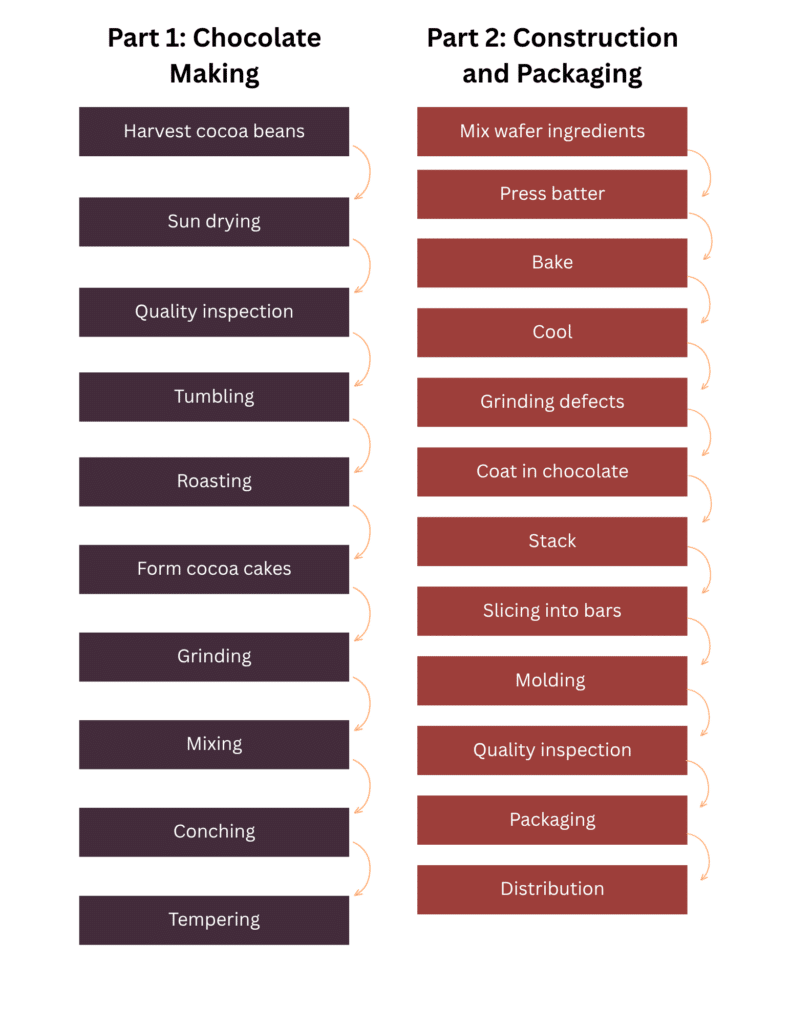
Ripe cocoa beans are harvested in Ghana and Ivory Coast and supported under the company’s Rainforest Alliance–certified cocoa program to ensure ethical farming (Food Tech Today, 2024). After harvesting, cocoa beans are placed to dry beneath the blazing sun for eight days to reduce moisture content and preserve volatiles. The beans are inspected for optimal dryness, size, texture, and aroma. Then, the cocoa beans are delivered into the factory, tumbled in a rotating drum, and air-blown to remove the shells. The beans are roasted in a large roaster to develop their chocolate aroma. Then, they are ground into cocoa butter and pressed using a hydraulic press to form cocoa cakes. The cocoa cakes are ground once again into a fine cocoa powder.
Cocoa powder is mixed with ingredients such as sugar, milk powder, and cocoa butter in a multi-ton mixer. A thick chocolate paste is formed and refined through conching, a step that grinds chocolate particles into finer sizes to achieve a creamy and velvety smooth texture. The chocolate is then tempered to prevent the formation of undesirable crystals, resulting in a glossy and luscious finish (Business Stories, 2024).
Additionally, KitKats feature thin and crispy wafers. The wafers are made from wheat flour, water, sugar, vegetable fats, baking soda, and salt. The wafer batter is pressed through ultra-precise nozzles into individual KitKat molds for even distribution (Business Stories, 2024). The molds are baked in ovens at high temperatures, then cooled with cold air to retain crispiness. Defective KitKat bars are ground up and used to make the filling inside the bars. Afterwards, layers are placed on a conveyor belt and draped in chocolate. Wafers are stacked and filled to stack layers of chocolate filled wafers. These wafer bars are cut into even portions, dropped into molds, and coated in a thick layer of molten milk chocolate. Finally, they are quality inspected and wrapped in shiny foil for warehouse delivery.
Sensory Analysis

To understand the scientific principles behind KitKat, there are several sensory properties that define the sweet treat. They are known for their embossed KitKat lettering on each individual bar and uniform coating. The exterior is a glossy dark brown with a smooth and immaculate finish. Once broken, they have a clear snap and light crunch from the wafers. The chocolate has a melting mouthfeel, luscious, sugary and creamy taste with fragrant notes of malt.
Origin of Emulsifiers and Chemistry
KitKats like other snacks require emulsifiers and originate from emulsions. Emulsions are derived from the word “emulgere” and means “milk out” in Latin (Lissant, 1988). Formulated emulsions have existed since dawn as emulsions can be found in nature such as plant saps and inks. They can be defined as a mixture of immiscible substances. There are two predominate types known as oil in water and water in oil emulsions. Oil in water emulsions include milk and water in oil emulsions include margarine. Emulsions include a continuous phase which is the main medium and dispersed phase where droplets of a substance are scattered in the continuous phase.
While emulsions may appear to be simple, when analyzing the nature of emulsions, there is a chemistry behind why mixtures require emulsifiers. Emulsions are considered thermodynamically unstable because the particles are immiscible and naturally tend to separate (David & Akhondi, 2023). One main reason would be due to polarity, water and oil do not mix because water is polar and oil is nonpolar. Polarity describes uneven electrical charge distribution causing water and oil to separate as polar molecules “mix together” by creating hydrogen bonds. To resolve this, emulsifiers are added to emulsions because they contain a hydrophilic (water loving) head and hydrophobic (water fearing) tail to prevent water and oil droplets from interacting and separating apart. As a result, emulsifiers became a solution to stabilize these mixtures in food products and in commercial products,
Functional Properties
The ingredient list for KitKats can be found in the figure below. A disagreement between consumers and formulators would be the ingredients used in ultra-processed foods. While clean labeling and natural ingredients are all the rave, consumers often forget the functional properties associated with each ingredient on the list (Hasenhuettl & Hartel, 2019).
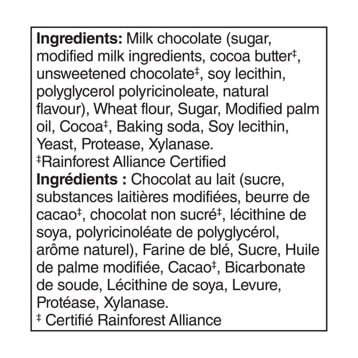
Chocolate is comprised of modified milk ingredients which are milk-derived concentrates such as casein, milk serum proteins, whey and milk components (Nestlé, 2024). They have been changed to preserve the foods and lower the cost of production instead of using pure milk. Secondly, cocoa butter is the foundation of chocolate providing the distinctive shine, smooth and melting quality and aroma.
Milk chocolate is a continuous fat phase and requires emulsifiers to suspend the sugar and milk ingredients (Pombal et al., 2024). Soy lecithin is known to control viscosity in chocolate and obtained by degumming soybean oil. It may also be chemically altered to change the surface properties. This would include making isolates and cleaving ester bonds. This is important during the conching and refining steps as they control the rheological properties of the chocolate paste (Hasenhuettl & Hartel, 2019). Additionally, it decreases production by lowering the cocoa butter necessary to reach the desired flow characteristics and saves mixer energy (Pombal et al., 2024). On the other hand, polyglycerol polyricinoleate is a moisture scavenger and retains fluidity during molding. To enhance flavour, natural flavours are incorporated and are essential oils/extracts that contain aromatic substances (Hasenhuettl & Hartel, 2019).
Wafers
The second part of the ingredient list includes the wafer ingredients. Firstly, wheat flour is used because its protein content is beneficial for gluten formation and integrity in the wafer batter. Sugar is essential to develop that caramelized flavour and reduce water activity in the product to retain a crisp and light structure. Soy lecithin acts as a binding agent and smoothens the wafer mixture. Yeast and baking soda are used as leavening agents to neutralize each other. Modified palm oil changes the molecular fatty acid chain of standard palm oil through interesterification (rearrangement of fatty acids). Furthermore, modification achieves the desired mouthfeel and melting point (Mills et al., 2017).
Enzymes
Another key component would be enzymes. These two enzymes are protease and xylanase which are used to break down protein and hemicellulose in plants called xylan (Sadeghian-Motahar et al., 2025). Protease breaks down gluten in wafers to prevent the formation of a strong gluten network. Subsequently, the results yield a uniform texture with each bite of wafer sheets (Sadeghian-Motahar et al., 2025). After treatment, the protein’s secondary structure changes which decreases viscosity, elevates protein solubility and better dough consistency. Xylanase decreases viscosity by breaking apart arabinoxylans that are responsible for thickening wafer batter by reducing water binding and non-covalent interactions (Sadeghian-Motahar et al., 2025).
Conclusion
All in all, this article explored KitKat manufacturing and the scientific principles of each ingredient. With the hype for additive free products, consumers tend to forget the chemical and quality aspects that may affect their food by omitting these “bad ingredients”. As stated in the article, additives have many functional roles in maintaining that glossy and smooth mouthfeel. The question behind health and safety of consuming KitKat bars does not allow lie on the responsibility of manufacturers, but for consumers to make their individualized decisions about snacking on KitKats part of their dietary restrictions. At the end of the day, a healthy diet requires meeting other nutritional requirements to have a balance of macronutrients and micronutrients.
About the Author

Bertina Do is a recent Food Science alumni at the University of Guelph. Currently, she is focused on starting a career in functional foods and nutricosmetics. Her main interests in the food industry are targeted at food chemistry and novel processing techniques. Over the past year, she has focused on quality assurance research. Her latest project was focused on comparing the decontamination and quality of baby carrots treated with high-voltage plasma-activated water (HV-PAW) and atmospheric Cold Plasma (HVACP).
Sources
- Business Stories. (2024, October 6). How KitKats are made in Factory! (Full KitKat Factory process) [Video]. YouTube. https://www.youtube.com/watch?v=r1k-KhCd50Y
- David, M. N. V., & Akhondi, H. (2023, July 30). Emulsions. StatPearls – NCBI Bookshelf. https://www.ncbi.nlm.nih.gov/books/NBK559084/
- Food Tech Today. (2024, December 21). How KitKat are made in a factory | See how they make 8 million bars every day! [Video]. YouTube. https://www.youtube.com/watch?v=jf2fm76S2eo
- Hasenhuettl, G. L., & Hartel, R. W. (2019). Food emulsifiers and their applications. https://doi.org/10.1007/978-3-030-29187-7
- Hersheyland. (n.d.). Kit Kat. https://www.hersheyland.com/kit-kat
- Lissant, K. J. (1988). Emulsification and demulsification — An historical overview. Colloids and Surfaces, 29(1), 1–5. https://doi.org/10.1016/0166-6622(88)80168-9
- Mills, C. E., Hall, W. L., & Berry, S. E. E. (2017). What are interesterified fats and should we be worried about them in our diet? Nutrition Bulletin, 42(2), 153–158. https://onlinelibrary.wiley.com/doi/10.1111/nbu.12264
- Pombal, M., Marcet, I., Rendueles, M., & Diaz, M. (2024). Emulsifiers: their influence on the rheological and texture properties in an industrial chocolate. Molecules, 29(21), 5185. https://doi.org/10.3390/molecules29215185
- Nestlé. (2024, January 31). Modified Milk Ingredients in Nestlé Products. https://www.madewithnestle.ca/help/modified-milk-ingredients.html
- Sadeghian-Motahar, S. F., Garcia, J. R., Tosi, P., Kuschel, B., Merz, M., Osborne, J., & Chatzifragkou, A. (2025). Impact of a protease and xylanase cocktail on the physicochemical properties of wafer batter and sheets. Future Foods, 12, 100830. https://doi.org/10.1016/j.fufo.2025.100830
- Schmid, T., Gillich, E., André, A., Kinner, M., Chetschik, I., & Müller, N. (2025). Physically modified plant oils as alternatives to palm fat: Effects on physical and flavour properties of chocolate fillings. Foods, 14(7), 1179. https://doi.org/10.3390/foods14071179


Comments are closed