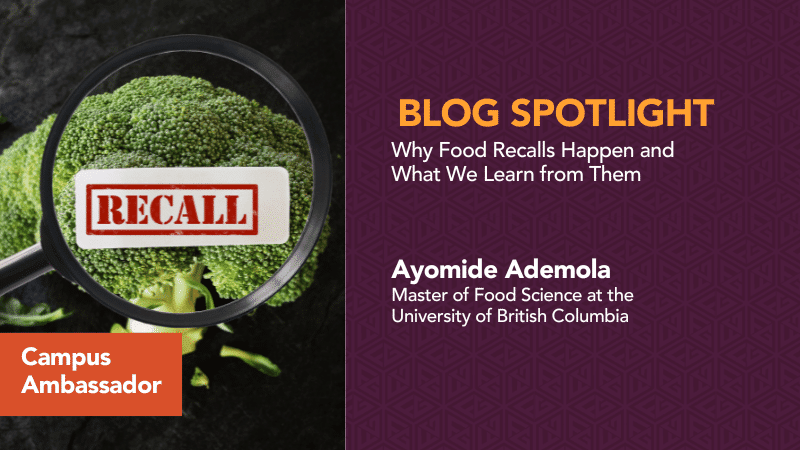

Why Food Recalls Happen and What We Learn from Them
Last Updated on May 28, 2026
We often consider food recalls from the perspective that they are bad, which is valid and understandable because they pose risks to public health. However, ironically, food recalls can also be seen as a good indicator that our food system is strong because we are able to detect, trace and remove unsafe foods from the market early. (Wowak et al., 2021)
Food recalls occur when something in the food system fails, yet each recall provides an opportunity to learn and prevent future failures, ultimately contributing to a safer food supply.
Major causes of Food Recalls in Canada
Before we discuss the implications of food recalls in regards to different stakeholders and the lessons we can learn from them, here are the two major causes of food recalls in Canada (Canadian Food Inspection Agency, 2025a):
- Pathogen contamination: Pathogens, especially bacteria such as E. coli, Listeria, and Salmonella, are leading causes of recalls and outbreaks in Canada and many other countries in the world.
- Undeclared allergens and mislabeling: This occurs when priority allergens such as eggs, milk, mustard, peanuts, crustaceans & molluscs, fish, sesame seeds, soy, sulphites, tree nuts (almonds, Brazil nuts, cashews, hazelnuts, macadamia nuts, pecans, pine nuts, pistachios and walnuts), wheat and triticale are present in a food but are not mentioned on the food label as mandated by regulations, or when labelling/packaging errors happen and lead to incorrect information (Health Canada, 2023). This remains one of the most frequent triggers of recalls in Canada.
Other causes could be chemical (like cleaning chemicals) or extraneous material contamination, like finding stones, broken glass, or metal fragments in a food.
“The CFIA oversees approximately 154 recall incidents a year.” (CFIA, 2025b)
Implications of food recalls
1. Implications for Consumers
Food recalls protect consumers from unsafe products that are contaminated or mislabeled, which may cause illnesses or allergic reactions. Canadians can stay informed about the latest recalls and safety alerts by signing up for the CFIA email list. Additionally, they can help build a stronger food system by reporting food safety concerns (Health Canada, 2025).
2. Implications for Food Businesses
Recalls can cost food businesses lots of money and reputational damage. Recalls also expose gaps in preventive controls or labelling practices, thereby prompting businesses to improve existing systems.
3. Implications for the Regulatory Body
Food recall situations could reveal the loopholes in existing policies and regulations. Consequently, recalls can help to reevaluate and adjust policies, improve surveillance and foster relationships with other stakeholders (ex. industry and public health agencies) in the food system.
What can we learn from recalls?
The major lesson from food recalls is that food safety is a shared responsibility. It is important to acknowledge that our food system is complex and there is a need to pay attention to all details as much as possible by evaluating all things that can possibly go wrong, having a preventive plan and adhering to the government regulations and guidelines.
We all depend on the food system, and it is important for all stakeholders (government, food industry and consumers) to play their roles.
Canada has one of the safest food systems in the world (Sutherland et al., 2020), and it is the shared responsibility of consumers, food businesses, and regulatory bodies to preserve this legacy and protect everyone.

About the author: Ayomide is a Master of Food Science (MFS) student at the University of British Columbia (UBC) with a background in nutrition and dietetics (Diploma and BSc). His passion lies in food regulation (especially food labels), safety, processing and research. Outside of food science, he loves reading and talking about historical events and documentaries.
References
Canadian Food Inspection Agency. (2025a). Food safety investigations and recalls – inspection.canada.ca. Government of Canada https://inspection.canada.ca/en/food-safety-industry/investigations-and-recalls
Canadian Food Inspection Agency. (2025b). Statistics: Food recall incidents and food recalls – inspection.canada.ca. Government of Canada https://inspection.canada.ca/en/food-safety-consumers/canada-s-food-safety-system/food-recall-incidents-and-food-recalls
Health Canada. (2023). Common food allergens – Canada.ca. Canada.ca. https://www.canada.ca/en/health-canada/services/food-nutrition/food-safety/food-allergies-intolerances/food-allergies.html
Health Canada (2025). Food recalls and alerts. Canada.ca. https://www.canada.ca/en/services/health/food-recalls-alerts.html
Sutherland, C., Sim, C., Gleim, S., & Smyth, S. J. (2020). Consumer insights on Canada’s food safety and food risk assessment system. Journal of Agriculture and Food Research, 2, 100038. https://doi.org/10.1016/j.jafr.2020.100038
Wowak, K. D., Craighead, C. W., Ketchen, D. J., & Connelly, B. L. (2021). Food for thought: Recalls and outcomes. Journal of Business Logistics, 43(1). https://doi.org/10.1111/jbl.12275

leave your comment